

Historically, the West Virginia Turnpike was a two-lane road with treacherous curves and a tunnel (which has since been decommissioned). Construction began in 1952, several years before the Eisenhower Interstate System was funded. It was only in 1987 that the entire length of the turnpike was upgraded to Interstate standards. Due to the difficulty and lives lost in construction, it has been called “88 miles of miracle.”
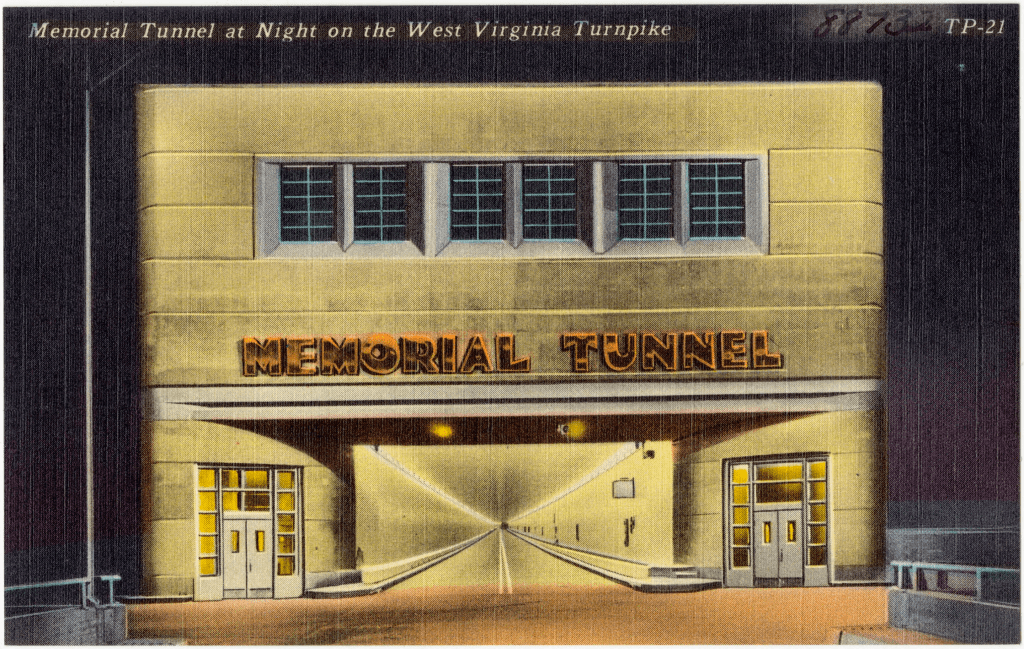
West Virginia’s Memorial Tunnel, located near Standard, WV (about 28 miles southeast of Charleston, WV) opened November 8, 1954 as part of the West Virginia turnpike, a two-lane tunnel that connected the 88 miles between Princeton and Charleston, West Virginia. The 2800-foot, two-lane tunnel construction required the movement of 30 million cubic yards of earth. It was the first tunnel in the nation to be monitored by television.
In 1987, the tunnel was bypassed by an “open cut” that displaced earth from a 371 foot cut in the mountain to a 311 foot deep fill in the adjacent valley (and replaced the Sergeant Stanley Bender bridge, named for a West Virginia Congressional Medal of Honor recipient, that had projected from the south entrance to the tunnel). This cut moved 10 million cubic yards of earth, and yielded about 300,000 tons of coal from the mountain. The turnpike tunnel was closed and Interstate 64/77 now runs adjacent to the tunnel.
Since being bypassed, the tunnel has become an unusual testing and training facility. From 1990 to 1997, the Federal Highway Administration extensively modified the tunnel and conducted the Memorial Tunnel Fire Ventilation Test Program. From 1993-1995, fires were set in the tunnel to test ventilation designs for Boston’s Central Artery/Tunnel project. In 1997 the tunnel became a storage site for the West Virginia Turnpike.
In 1997 Major General Allen E. Tackett, Adjutant General of West Virginia envisioned turning this abandoned highway tunnel into a range for military and civilian first responders to train. The U.S. Congress, recognizing the need for additional WMD training, required the Department of Defense to “Establish a cost-effective CM/CT facility for military first responders and concurrent testing of response apparatus and equipment at the Memorial Tunnel facility”. In 1999, the Department of Defense Consequence Management Program Integration Office initiated planning and development of a training center in the more than 79,000 square feet of the two-lane, 2,800-foot-long highway tunnel to train local, state, federal, and military response units.
In May 2000, a 5-phase project began to convert the Memorial Tunnel into the Center for National Response (CNR), an exercise facility for Weapons of Mass Destruction (WMD) Consequence Management (CM) and Counterterrorism (CT). Sets were constructed within the tunnel, including a post-blast rubble area, a subway station, illicit drug laboratories, a confined space training area, and a highway incident scene.
Today, the Center for National Response is managed by the West Virginia National Guard as an element of the Joint Interagency Training and Education Center. The tunnel is ideal for consequence and crisis management emergency response training and provides a realistic environment where emergency response teams can readily practice techniques designed to mitigate the effects of a WMD incident in an underground highway, train, or subway tunnel. Additionally, the tunnel provides an excellent base for training on HAZMAT response; simulated agent testing; illicit chemical, biological, or drug laboratory entry and containment; EOD operations; underground search and rescue; counter terrorist tactics; and hostage rescue.
Per Wiki:
The Memorial Tunnel is a 2,802 feet (854 m) two-lane vehicular tunnel that formerly carried the West Virginia Turnpike through/under Paint Creek Mountain in Standard, West Virginia in Kanawha County. Closed to interstate traffic since 1987, the tunnel serves as the Center for National Response for military first responders to train for various situations that may arise in such a location without alarming the general public.
The tunnel’s bypass is reminiscent of the Pennsylvania Turnpike bypassing the Laurel Hill Tunnel in 1964, followed by the bypass of the Rays Hill and Sideling Hill Tunnels in 1968.
History
Construction of the Memorial Tunnel commenced in 1952, and it officially opened to traffic on November 8, 1954, at a final cost of $5 million. Its construction required the movement of 91,000 cubic yards (70,000 m3) of earth, and it was the first tunnel in the nation to have closed-circuit television monitoring. At the time, it was called “88 miles of miracle.”
Turnpike Upgrades
The turnpike became heavily used, and by 1976, upgrades to the Turnpike from two-lanes to four-lanes had commenced; by 1983 all but the Memorial Tunnel had been completed. The remaining tunnel created a bottleneck–the 4-lane, divided highway turnpike had to merge into the two-lane, two-way traffic configuration of the tunnel, which also had a lower speed limit. This resulted in traffic backups during periods of increased traffic, such as holiday travel seasons.
Bypassed
Instead of upgrading and expanding the tunnel, a 1.72 miles (2.77 km) bypass was constructed going around both the tunnel and the Bender Bridge over Paint Creek. Costing $35 million to complete, 10 million cubic yards (7,600,000 m3) of earth were removed in addition to 300,000 tons of coal being removed from the mountain. The last vehicle would pass through the tunnel on July 7, 1987, and it would subsequently close for use for pass-through vehicular traffic.
Alternate Use
Between 1992 and 1995, the Department of Transportation entered a deal with the state to utilize the abandoned tunnel for smoke, fire and ventilation experiments. These experiments were carried out to design better developed ventilation systems for the tunnels being constructed as part of the Big Dig in Boston; the results of the tests were also incorporated into the design of the Channel Tunnel. These experiments also resulted in the Federal Highway Administration allowing jet fans for ventilation in tunnel construction, which was a significant change to their original ventilation designs. The lasting legacy of the Memorial Tunnel Fire Test Program is in both changes in ceilings materials used in tunnel construction as well in the approved use of jet fans for ventilation during construction.
By 2000, the tunnel had been selected as the location where the Center for National Response would conduct anti-terrorism training exercises. The current facilities offered in the center include:
- A rubble area to simulate collapsed buildings
- An emergency egress trainer
- A subway station, complete with 800 feet (240 m) of track and two subway cars from Boston’s Green Line
- A drug enforcement section
- A highway tunnel section, complete with a New York City Transit Authority bus, firetrucks, a tractor-trailer and other vehicles
- A 50-car pileup wreck complete with hazardous materials
Groups from around the country are sending personnel to West Virginia to train in the facility. In all, about 160,000 first responders have been trained by West Virginians.

03 Feb 1955, Thu • Page 4

02 May 1957, Thu • Page 4


22 Jan 1950, Sun • Page 1

03 Feb 1950, Fri • Page 4

23 Mar 1950, Thu • Page 1

24 May 1951, Thu • Page 1
 Thoughts and Ponderances